Crown Chakra Healing For Horses: An 11-Step Guide To Balance
Crown Chakra Healing For Horses offers a gentle, spiritual approach to exploring awareness, inner peace, and the meaningful connection between horses and their owners.
In traditional chakra philosophy, the Crown Chakra, also known as Sahasrara, symbolizes spiritual consciousness, wisdom, and a deeper connection with the universe.
Horse owners can explore these spiritual concepts through Reiki-inspired meditation, positive intentions, mindful observation, and peaceful interactions that respect their horses’ natural behaviour.
These practices can also encourage owners to slow down, become more attentive, and create calm moments together without expecting their horses to participate in spiritual activities.
This guide explores how to incorporate spiritual mindfulness into everyday horse care while prioritizing your horse’s individual preferences, physical comfort, emotional well-being, and natural needs.
What Is Crown Chakra Healing For Horses?
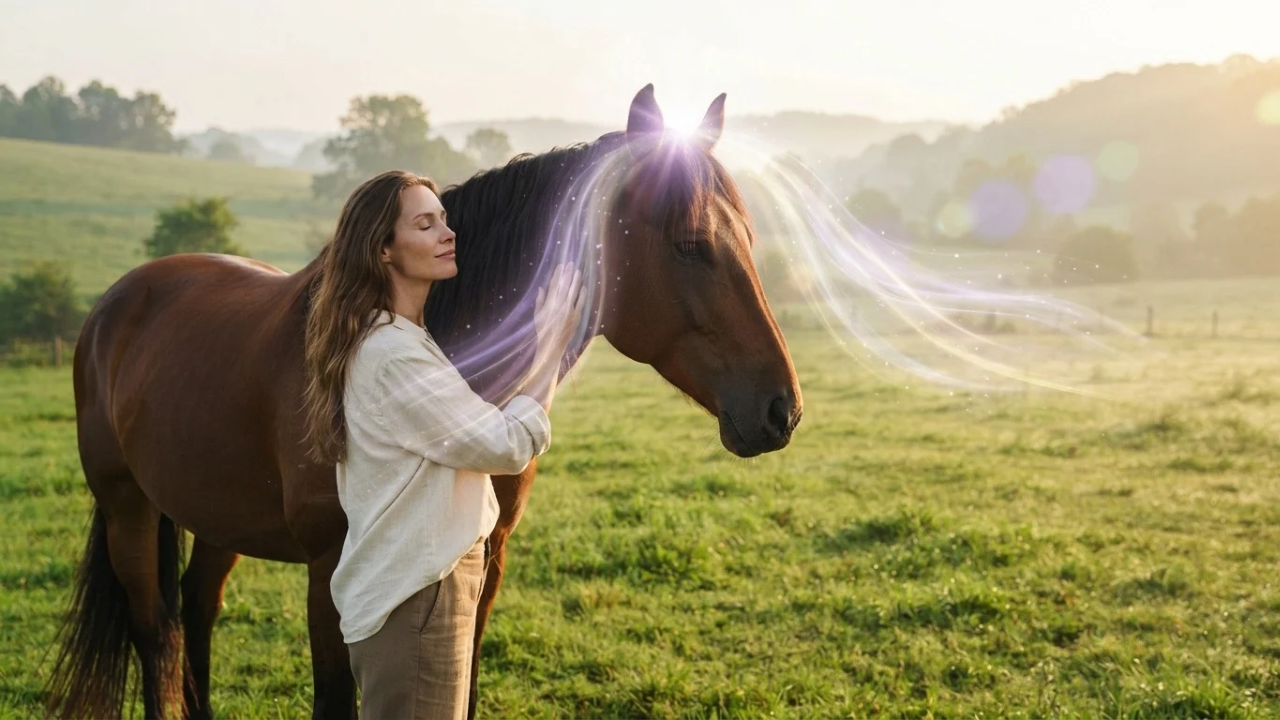
Crown Chakra Healing For Horses is a spiritual, energy-based practice that focuses on the Sahasrara, or Crown Chakra, traditionally associated with the top of a horse’s head. You can learn more about these concepts in our guide to animal chakras.
In chakra traditions, this energy centre is associated with spiritual awareness, inner peace, balance, and connection with the surrounding world. Horse parents may explore these concepts through gentle energy work, meditation, and calming interactions.
Our guide to horse chakra healing offers additional insights into incorporating these spiritual traditions into everyday horse care.
Benefits Of Crown Chakra Healing In Horses
Crown Chakra Healing For Horses offers a spiritual approach to encouraging mindfulness, peaceful interactions, and a deeper appreciation of the human-horse relationship.
Although chakra healing is not a scientifically established equine treatment, its associated practices can encourage owners to pay closer attention to their horses’ behaviour, comfort, and emotional needs.
Combining Reiki and chakra healing for pets is one way some owners explore these spiritual traditions alongside gentle, everyday animal care.
The following eight benefits highlight how mindful observation, positive interactions, and consistent routines can support a more thoughtful and compassionate approach to caring for horses.
1. Encourages A Deeper Connection With Your Horse
A Crown Chakra routine can remind horse parents to spend unhurried time with their horses. Quiet observation, predictable handling, and familiar companionship create opportunities to learn what your horse accepts and enjoys.
Exploring Reiki and animal communication can encourage greater awareness of your horse’s body language. Research suggests that horses remember previous interactions with people.
These actions do not prove that a chakra has changed, but they can make daily care more attentive. Horses may approach people after positive experiences and avoid unpleasant interactions.
Let your horse’s voluntary responses guide these peaceful moments, helping you develop a more respectful and rewarding relationship.
2. Encourages A More Peaceful Interaction Environment
The spiritual theme of the Crown Chakra includes peace, awareness, and connection. Using it as a personal meditation focus may encourage horse parents to slow down before handling their horses.
Taking a few moments to practise mindfulness and meditation can encourage a calmer approach to everyday interactions. Our guide to using Reiki to calm anxious pets explores another gentle approach.
A less hurried horse parent can pay closer attention to movement, surroundings, and the animal’s responses. This is not evidence that Reiki directly calms horses.
Instead, the practical value lies in your own mindful approach and in keeping interactions predictable, gentle, and appropriate for each horse.
3. Improves Awareness During Everyday Horse Care
Mindfulness can turn routine grooming or quiet companionship into an opportunity to observe rather than rush. You may notice how your horse responds to familiar brushes, your approach, or changes in the environment.
Exploring animal aura and chakra reading offers a spiritual perspective on animal awareness, while practical horse care tips and tricks can help you develop attentive daily routines.
These observations can help you adapt everyday care to your horse’s preferences. They cannot diagnose a health problem, and a single behaviour should not be interpreted in isolation.
Consistent attention may help you recognize when something differs from your horse’s usual pattern and seek veterinary advice sooner.
4. Helps You Understand Your Horse’s Individual Preferences
Horses differ in temperament, past handling, age, and comfort with people. A home-based Crown Chakra routine can remind horse parents not to expect identical responses from every animal.
One horse may welcome grooming, while another may prefer quiet company at a respectful distance. Respecting these differences reflects the principles of ethical animal Reiki, which emphasize an animal’s freedom of choice.
Our guide to maintaining a healthy coat in horses offers practical grooming advice, but each horse’s comfort and preferences should guide the experience.
Research reviews note that individual differences and human control can affect how equine behaviour is interpreted, making observation and freedom of movement especially important during interactions.
5. Supports More Respectful Human-Horse Relationships
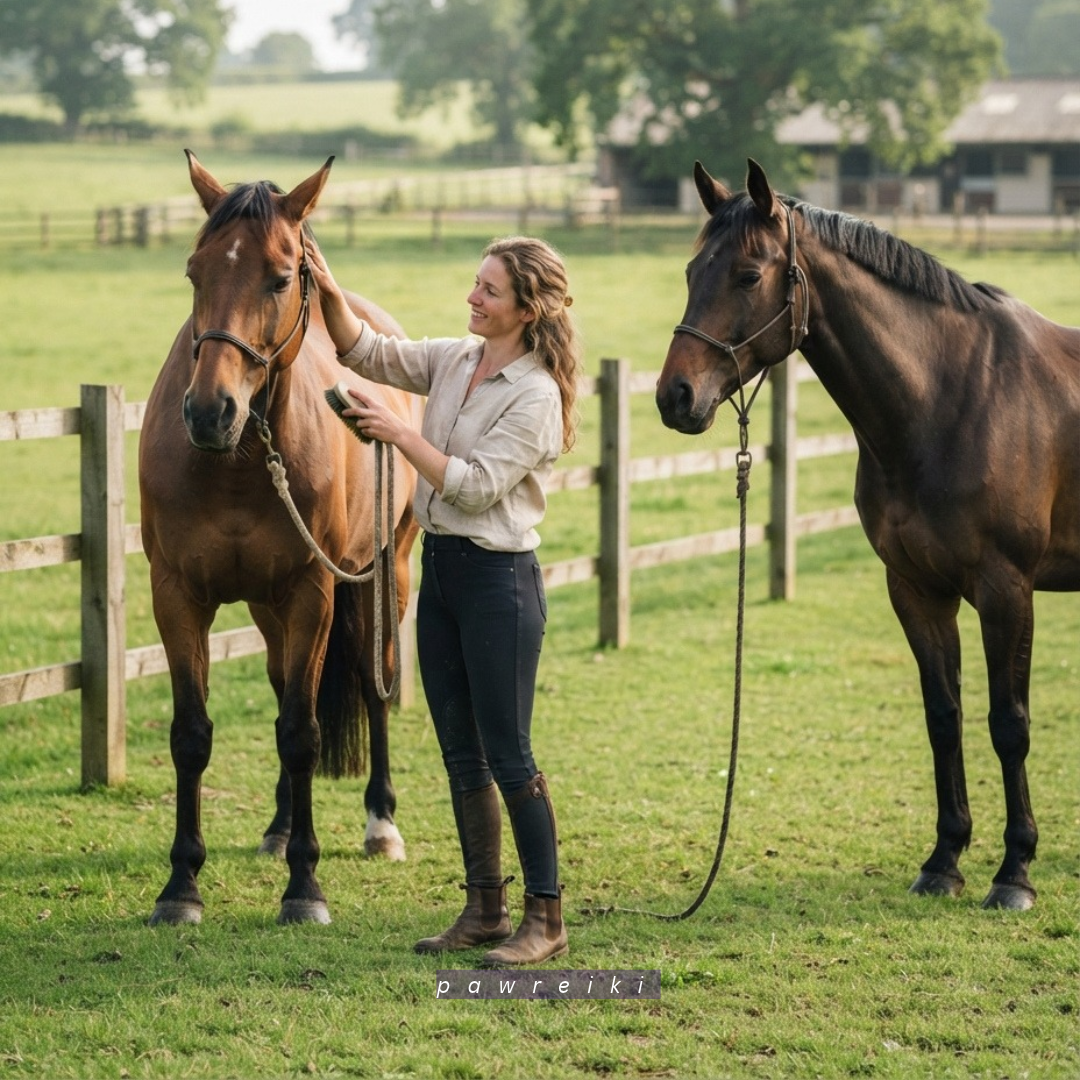
A personal Reiki-inspired practice can encourage horse parents to use a gentle voice, predictable movements, and patient handling. Our guide to Reiki for horses explores this gentle approach.
These habits may support more considerate interactions when combined with appropriate horse management. The benefits of equine therapy also highlight the importance of human-horse relationships.
Research reviews of human-horse interactions have found that positive experiences can be associated with approach behaviour when horses have freedom of movement.
In contrast, negative experiences can be associated with avoidance. This highlights the importance of respecting your horse’s choices rather than claiming Reiki itself changes behaviour.
6. Creates Opportunities For Personal Relaxation
Quiet time beside a horse may also offer horse parents a chance to pause, breathe naturally, and focus on the present. Our guide to meditating with animals offers additional ideas.
You can use Crown Chakra imagery as a personal reminder of gratitude and connection. These peaceful moments may help you appreciate the companionship you share with your horse.
Any relaxation you experience is your own subjective response; it should not be presented as a proven treatment for the horse. Keeping the practice brief and voluntary can make it a pleasant addition to ordinary companionship without replacing exercise, turnout, or social contact.
7. Encourages Greater Attention To Your Horse’s Well-Being
A mindful routine can prompt you to check more than your horse’s mood. Notice appetite, water intake, movement, coat condition, hoof comfort, and interest in companions.
These everyday observations cannot replace veterinary examinations, but they can help you describe changes clearly when needed. Our guide to Reiki and traditional veterinary care explains their different roles.
Research on equine welfare emphasizes meeting behavioural and physical needs, including forage, space, and social contact. Practical routines, including hoof care for horses, support these foundations alongside spiritual reflection.
8. Builds A Consistent Home-Based Wellness Routine
A short, repeatable moment of quiet observation can fit naturally around grooming or another familiar care activity. Our guide to Root Chakra Healing For Horses explores grounding and familiar routines.
Over time, you may become more consistent about noticing preferences and recording changes. Learning about the causes and effects of stress in horses can also help you recognize changes in behaviour.
Keep your horse’s normal schedule intact, including forage, turnout, movement, rest, and contact with other horses. The chakra framework can give your personal routine symbolic meaning, while evidence-informed care remains central.
Consistency should never mean forcing your horse to participate or repeating an activity that causes discomfort. Allowing your horse to choose whether to engage helps build trust and keeps these quiet moments comfortable and enjoyable for both of you.
Step-By-Step Guide To Crown Chakra Healing For Horses At Home
There is no scientifically validated Crown Chakra healing protocol for horses. However, the following 12 steps offer a gentle, Reiki-inspired spiritual routine that can complement responsible horse ownership.
These practices focus on mindful observation, peaceful surroundings, and respectful interaction. Keep every activity voluntary, prioritize your horse’s safety and comfort, and never replace essential veterinary care with spiritual practices.
Step 1: Understand Your Horse’s Physical And Emotional Needs
Before introducing Crown Chakra practices, learn what is normal for your horse. Consider its age, temperament, handling history, health, and usual daily routine.
Notice its appetite, movement, posture, social behaviour, and response to familiar people. These observations provide a useful baseline for recognizing meaningful changes.
Our guide to Animal Reiki For Anxiety And Stress Relief explores gentle approaches to stressful experiences. Understanding hands-on versus hands-off Reiki can also help you respect your horse’s comfort and personal space.
If your horse has recently become withdrawn, restless, sensitive, or reluctant to move, seek veterinary advice before introducing a new wellness activity.
Do not assume that unusual behaviour reflects blocked energy. A responsible home routine starts with your horse’s actual needs, and spiritual reflection should never delay assessing possible pain or illness. Keep notes factual.
Step 2: Choose A Familiar And Comfortable Environment
Choose a familiar place where your horse can remain comfortable and move freely. A secure paddock, quiet stable area, or familiar grooming space may be suitable when the footing is safe. See our guide to preparing your home for an animal Reiki session.
Remove loose equipment, sharp objects, and anything that could cause injury. Consider ventilation, temperature, noise, and access to water. Avoid separating your horse from companions if this causes distress.
Our article on preparing your pet for a Reiki session offers additional guidance. Keep normal access to forage and social contact unchanged, and avoid unnecessary activity nearby.
The aim is not to create a special healing chamber, but to make ordinary surroundings calm, predictable, and safe for quiet companionship. Respecting your horse’s comfort also helps with building trust through animal Reiki.
Step 3: Prepare Yourself Through Personal Meditation
Prepare yourself before approaching your horse. Stand or sit somewhere safe, take a few natural breaths, and allow your attention to settle. In traditional Reiki, people may use meditation and a positive intention to focus a session.
For a Crown Chakra theme, choose words such as awareness, gratitude, peace, or connection. This is a personal spiritual exercise; there is no established evidence that your intention transfers measurable healing energy to the horse.
Its practical value is that it may remind you to slow down, avoid hurried handling, and give your horse your full attention. Exploring meditation techniques and their health benefits can also support your personal mindfulness practice. This also supports consistent, thoughtful handling.
Step 4: Approach Your Horse Calmly And Safely
Approach in a way that your horse already knows and accepts. Speak softly if your horse is accustomed to your voice, move predictably, and avoid sudden gestures.
Approach from a visible direction, usually from the side or near the shoulder, rather than walking directly behind. Stay aware of your horse’s movements and reactions.
Do not stand where you could easily be trapped or kicked. Use the usual halter and lead only if needed for safe handling, and never tie or restrain the horse solely to keep it present for Reiki.
Give your horse room to move and the freedom to step away. Familiar, low-pressure handling matters more than completing a ritual. Safety comes first, so remain alert throughout the interaction.
Step 5: Observe Your Horse Before Beginning
Before beginning, observe your horse without asking it to perform. Look at the whole body, including the ears, eyes, muzzle, neck, legs, tail, stance, and breathing.
Compare what you see with your horse’s normal behaviour, because one signal alone rarely explains how it feels. Repeatedly moving away, pinned ears, or tense muscles may indicate discomfort.
Agitation or unusual stillness may also warrant giving your horse more space or ending the activity. Understanding how animals show they are receiving Reiki offers another perspective on observing their responses.
A relaxed-looking horse is not automatically enjoying an interaction, particularly if movement is restricted. Let your horse leave freely, and treat its choices as more important than your planned meditation.
Allow these observations to guide future interactions, helping you respect your horse’s individual needs and preferences.
Step 6: Establish A Positive Crown Chakra Intention
Choose a simple intention that reflects the traditional meaning of Sahasrara, the Crown Chakra. You might focus on awareness, compassion, gratitude, or a respectful connection with your horse.
Silently repeat a short phrase, such as, “May I meet my horse with patience and understanding.” Keep the intention directed toward your own attitude rather than expecting the horse to feel a specific sensation.
Chakra systems are spiritual frameworks, not veterinary diagnostic systems. Our guide to the role of chakras in animal healing explores their traditional spiritual significance.
No scientifically validated test exists for a Crown Chakra imbalance in horses, so avoid interpreting ordinary behaviour as proof of one. Keep expectations gentle and realistic throughout the practice.
Step 7: Visualize The Crown Chakra Symbolically
In many chakra traditions, the Crown Chakra is associated with the top of the head and represented by violet, white, or sometimes a thousand-petalled lotus.
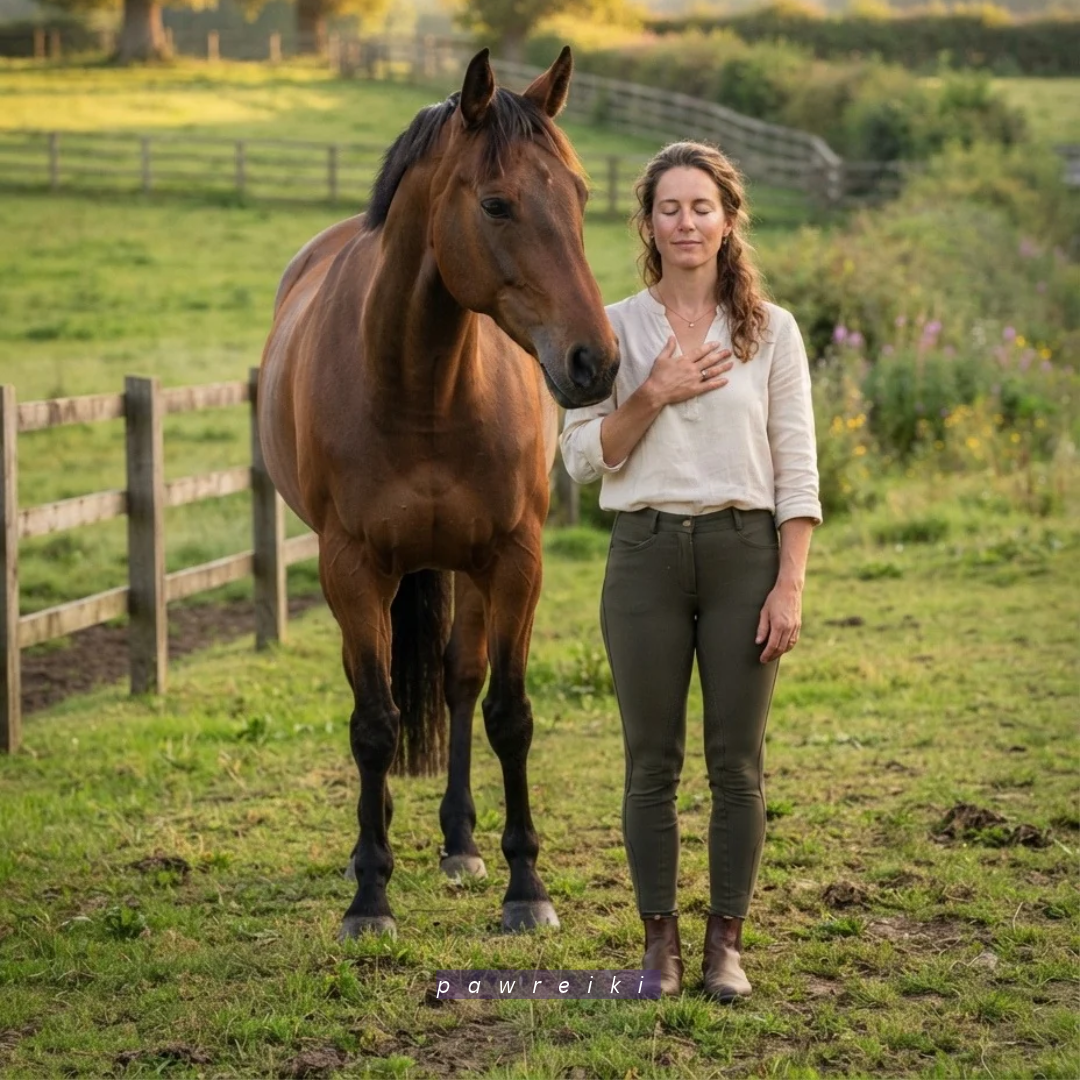
During your own meditation, you may imagine a soft violet or white light as a symbol of awareness and connection. Keep this visualization in your mind rather than shining lamps, lasers, or bright torches at your horse.
Do not apply oils, powders, or products to your horse’s head. The imagery is symbolic, not an anatomical treatment, and should never involve touching sensitive areas or interrupting your horse’s comfort.
If you enjoy exploring chakra symbolism, our guide to crystals for pet chakra healing offers additional spiritual perspectives. Keep crystals and other materials safely beyond your horse’s reach.
Step 8: Incorporate Gentle Contact Only When Welcomed
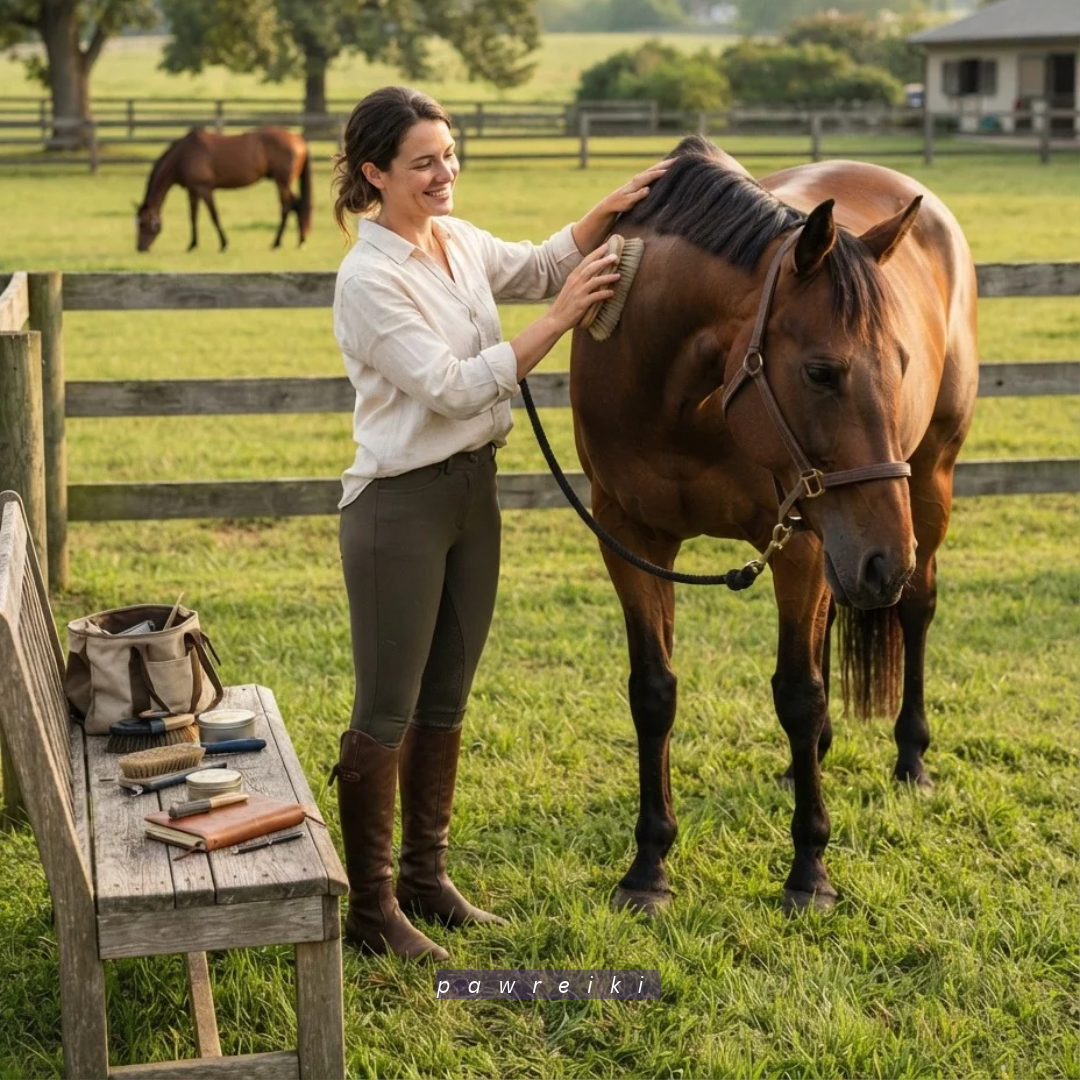
If your horse welcomes familiar contact, you may include ordinary gentle grooming in the routine. Choose areas it already accepts, such as the neck or shoulder, and use equipment and techniques you normally use safely.
Watch for changes in posture, facial tension, or attempts to move away. Stop if your horse shows discomfort, even if you believe the contact is spiritually meaningful.
Do not press the poll, ears, forehead, or any painful area. Our guide to hand positions for animal Reiki explores gentle approaches while respecting an animal’s personal space.
Reiki-inspired practice is not massage, physiotherapy, or a substitute for treatment. Keep grooming comfortable, brief, and guided by your horse’s response. Always prioritize comfort over completing the routine.
Step 9: Practice Mindful Breathing And Quiet Observation
You can continue your personal meditation while sitting or standing at a safe distance. Breathe naturally and notice the sounds, light, and movement around you.
Do not ask your horse to copy your breathing, stand still, close its eyes, or remain beside you. Horses have their own respiratory patterns and behavioural needs.
If your horse chooses to graze, look around, or walk away, allow it to do so when safe. Quiet observation may help you become more attentive to its natural behaviour.
However, this does not demonstrate that your horse has entered a meditative state or received an energy treatment. Let its behaviour guide you, and keep the experience comfortable and voluntary.
Step 10: Complete The Session Without Disrupting Normal Care
Keep your Crown Chakra session brief and flexible, allowing plenty of time for feeding, turnout, exercise, rest, and social contact. Choose a duration that suits your horse’s comfort and daily routine.
Finish whenever your horse loses interest or you need to attend to its usual care. There is no need to wait for yawning, a lowered head, or quiet standing before ending the session.
These behaviours can have different meanings, so let your horse’s individual responses guide you. A peaceful experience matters more than following a particular schedule or completing every step.
End calmly, remove any equipment you brought, and allow your horse to return to its preferred safe activity. Normal daily responsibilities should always come first.
Step 11: Record Your Horse’s Behaviour And Responses
After the session, make a brief note about the date, place, approximate duration, and what your horse did. Record observable details, such as whether it approached, moved away, grazed, or accepted familiar grooming.
Focus on your horse’s natural responses rather than interpreting every behaviour as a spiritual sign. Over time, these observations may help you recognize individual preferences and develop a deeper understanding of your horse.
Include relevant details about appetite, movement, and social behaviour if they differ from normal. These notes can also provide useful information when discussing changes with your veterinarian.
A simple record supports attentive horse ownership while allowing you to enjoy the personal spiritual meaning of your practice. Keep your notes factual, dated, and organized for future reference.
Frequently Asked Questions
Q1: Where Is The Crown Chakra Located In A Horse?
In traditional chakra philosophy, the Crown Chakra is symbolically associated with the top of the head. It represents spiritual awareness, consciousness, and a connection with the wider universe.
For horses, this location is a spiritual reference rather than a scientifically identified anatomical structure. You can use it as a focus for personal meditation and reflection.
Q2: Which Colour Represents The Crown Chakra In Horses?
Violet and white are commonly associated with the Crown Chakra. These colours traditionally symbolize spiritual awareness, higher consciousness, peace, and connection.
You can incorporate either colour into your personal meditation space through visualization or simple decorations. Choose whatever helps you feel peaceful and focused without disturbing your horse.
Q3: Which Crystal Is Traditionally Associated With Crown Chakra Healing?
Clear quartz and amethyst are commonly associated with Crown Chakra practices. Clear quartz traditionally symbolizes clarity, while amethyst is often linked to peaceful reflection and spiritual awareness.
You can include these crystals in your personal meditation area as symbolic objects. Keep them securely away from horses to prevent accidental ingestion or injury.
Q4: Can Crown Chakra Healing Reduce Stress In Horses?
Crown Chakra healing is a spiritual practice rather than a scientifically established treatment for equine stress. However, spending quiet time together can encourage more attentive and considerate interactions.
Calm handling, familiar surroundings, positive experiences, and opportunities for natural behaviour can support your horse’s everyday well-being. Let your horse’s individual needs guide these peaceful moments.
Q5: How Often Should You Practice Crown Chakra Healing With Your Horse?
There is no established schedule or ideal duration for Crown Chakra healing in horses. You can incorporate brief personal meditation into your regular horse care routine whenever it feels appropriate.
Some horse parents may enjoy a few quiet minutes each day, while others prefer occasional sessions. Keep the experience flexible and comfortable without interrupting feeding, exercise, rest, or social contact.
Q6: Can You Practice Crown Chakra Meditation Without Touching Your Horse?
Yes. You can practise Crown Chakra meditation while sitting or standing at a safe distance. Physical contact is unnecessary because the visualization and spiritual intention are part of your personal practice.
Your horse can continue grazing, resting, or moving freely while you meditate. This hands-off approach respects its personal space and allows companionship without expecting participation.
Q7: Can Crown Chakra Healing Help Improve A Horse’s Spiritual Connection?
Crown Chakra healing is traditionally associated with spiritual awareness and universal connection. Many people use this symbolism to reflect on compassion, gratitude, and their relationships with animals.
Although changes in a horse’s spiritual awareness cannot be scientifically verified, mindful observation and peaceful companionship may help you develop a more attentive and respectful relationship.
Q8: Can You Use Essential Oils During Crown Chakra Healing For Horses?
It is best to avoid essential oils during Crown Chakra practice with horses. Their concentrated fragrances may cause irritation or discomfort, particularly when used near sensitive areas.
Instead, choose fresh air, familiar surroundings, and quiet personal meditation. A peaceful environment without added fragrances helps your horse stay comfortable while you focus on your spiritual practice.
Helpful External Resources
If you’d like to explore pet wellness, behaviour support, or gentle healing practices further, here are trusted organizations and educational resources you may find helpful:
- American Veterinary Medical Association (AVMA) – General pet health, behaviour guidance, and care resources.
- ASPCA Pet Care Library – Behaviour tips, anxiety support, and animal-care information.
- VCA Animal Hospitals: Know Your Pet – Comprehensive articles written by veterinarians.
- International Center for Reiki Training (ICRT): Animal Reiki – Introductory information and classes for working with animals.
- Shelter Animal Reiki Association (SARA) – Ethical, animal-led Reiki practices and training.
Conclusion
Crown Chakra Healing For Horses offers a spiritual perspective on awareness, connection, and mindful horse ownership. Through personal Reiki-inspired meditation, peaceful surroundings, and respectful interactions, you can create meaningful opportunities to spend time with your horse at home.
The most valuable approach combines these spiritual activities with practical equine care, attention to natural behaviour, and respect for individual preferences.
A healthy human-horse relationship develops through patience, consistency, companionship, and a genuine understanding of everyday needs. By embracing these qualities, you can make quiet moments together more meaningful and rewarding.
I trust you enjoyed this article on the Crown Chakra Healing For Horses: An 11-Step Guide To Balance. Please stay tuned for more Reiki insights, pet wellness tips, and holistic lifestyle ideas.
Take care!
— JeannetteZ 🐾💜
💬 Your Opinion Is Important To Me
Do you have thoughts, ideas, or questions? I’d love to hear from you. Please leave your comments below or email me directly at Jeannette@pawreiki.com.
📚 More PawReiki Reads — Discover Energy Healing & Holistic Pet Wellness
💜 My #1 Recommendation for Online Success
Reiki has brought so much peace and purpose to my life, and sharing it online has been a true blessing. If you’ve ever dreamed of creating a gentle income stream around your love for animals and holistic healing, this platform gives you all the tools, training, and community support you need — no tech experience required.
🌟 See How Reiki Lovers Build Online Income — Try WA FreeNo credit card required · Free starter training included
Disclosure
This post may contain affiliate links. As an Amazon Associate and participant in other affiliate programs, I earn from qualifying purchases at no extra cost to you. Please read my full affiliate disclosure.