
Reiki For Fearful Cats: A 10-Step Guide For Cat Parents
Reiki For Fearful Cats offers a gentle way to share quiet, supportive moments with cats that are easily frightened, cautious, or unsure of their surroundings.
Some cats hide when visitors arrive, startle at everyday sounds, or need extra time before approaching people. Their fear may be obvious, or it may show up in subtle changes in their behaviour.
Reiki creates an opportunity to slow things down and spend peaceful time together without asking your cat to interact. Cats and Reiki can work particularly well together because your cat remains free to approach, stay at a comfortable distance, or leave whenever they choose.
This guide explores how to practise Reiki at home while respecting your cat’s boundaries and natural pace. You’ll also learn common signs of fear and ways to create a calm, low-pressure Reiki experience.
How To Practise Reiki For Fearful Cats At Home
Fearful cats often need extra time and space before they feel comfortable. A gentle Reiki practice can respect that need without asking them to interact before they are ready.
Creating a peaceful environment can help make the experience feel familiar and predictable. Your cat can remain nearby, watch from a distance, hide, or leave whenever they choose.
You don’t need to encourage physical contact or expect your cat to stay in one place. Hands-off Reiki can be especially suitable for cats that are nervous about being touched or approached.
Paying attention to your cat’s body language can help guide each session. Small changes in posture, movement, or distance can indicate whether your cat is comfortable with your presence.
The following steps focus on creating a quiet, low-pressure Reiki experience while letting your cat stay in control of their space and participation.
Step 1: Choose A Familiar, Low-Stress Space
The best place for a home Reiki session is usually somewhere your cat already knows. Preparing your home for an animal Reiki session doesn’t require an elaborate setup.
Before beginning, look around for anything that could disturb your cat. Frequent movement, unnecessary noise, or another pet entering the room may make it harder for a fearful cat to settle.
The space does not need to be completely silent. Familiar household sounds may be fine, as long as your cat has somewhere comfortable to rest and an easy way to move away.
Make sure a favourite hiding place or retreat remains accessible throughout the session. Safe places and opportunities to control interactions are especially important for cats that are easily frightened.
Key Point
A familiar space with an easy escape route is more important than creating an elaborate Reiki setting.
Step 2: Choose The Right Moment Instead Of Forcing A Schedule
Your cat’s natural routine can help determine a comfortable time for Reiki. When you prepare your pet for a Reiki session, choosing a time when they are already relaxed can help keep the experience gentle and familiar.
After eating, during a peaceful afternoon, or while resting in the evening may provide a natural opportunity. Starting when your cat is already settled can help keep Reiki from becoming another interruption.
If your cat is playing, exploring, eating, or enjoying another activity, you don’t need to interrupt them for a planned session. Reiki can wait until a quieter opportunity arises.
No fixed schedule or ideal time works for every cat. Let your cat’s mood and daily rhythm guide you to keep the practice flexible and centred on their comfort.
Key Point
Let your cat’s natural routine guide the timing rather than following a strict Reiki schedule.
Step 3: Prepare Yourself Before Approaching Your Cat
Before beginning Reiki, take a few moments to prepare yourself before offering Reiki to your pet. Sit comfortably, let your breathing relax and become natural, and put away distractions like your phone.
A quiet moment can help you become more aware of your own movements and your cat’s behaviour. This is especially helpful with a fearful cat that may be sensitive to sudden movement or unexpected attention.
Avoid reaching toward your cat or following them if they move away. Instead, stay quietly present and let your cat decide how much distance feels comfortable.
Preparing yourself in this way creates a more peaceful, predictable environment for sharing Reiki. It also helps you stay focused on your cat without expecting a particular response.
Key Point
A calm, settled presence helps create a gentle Reiki experience while letting your cat stay in control.
Step 4: Let Your Cat Choose Whether To Participate
Allowing your cat to choose whether to participate is especially important when sharing Reiki with a fearful cat. Settle into your chosen space without calling or encouraging your cat to come closer.
Your cat may choose to:
- Sit across the room.
- Watch from a doorway.
- Curl up on a sofa.
- Remain in a favourite hiding place.
- Walk toward you voluntarily.
Each response is perfectly acceptable. Your cat doesn’t need to sit beside you or stay in one place for you to quietly offer Reiki. Their willingness to remain at a comfortable distance can be part of the experience too.
A fearful cat may become uncomfortable when they cannot control the distance between themselves and another person. Keeping safe places accessible and allowing your cat to withdraw helps preserve their sense of choice.
Physical closeness is not a measure of a successful Reiki session. Building trust through calm connection begins with respecting your cat’s boundaries and allowing them to participate in their own way.
Heart chakra healing for cats can also provide cat parents with another gentle way to focus on connection while respecting their cat’s need for space.
Key Point
Let your cat decide whether to stay nearby, watch from a distance, approach voluntarily, or leave the Reiki session.
Step 5: Begin With Hands-Off Reiki If Your Cat Is Nervous
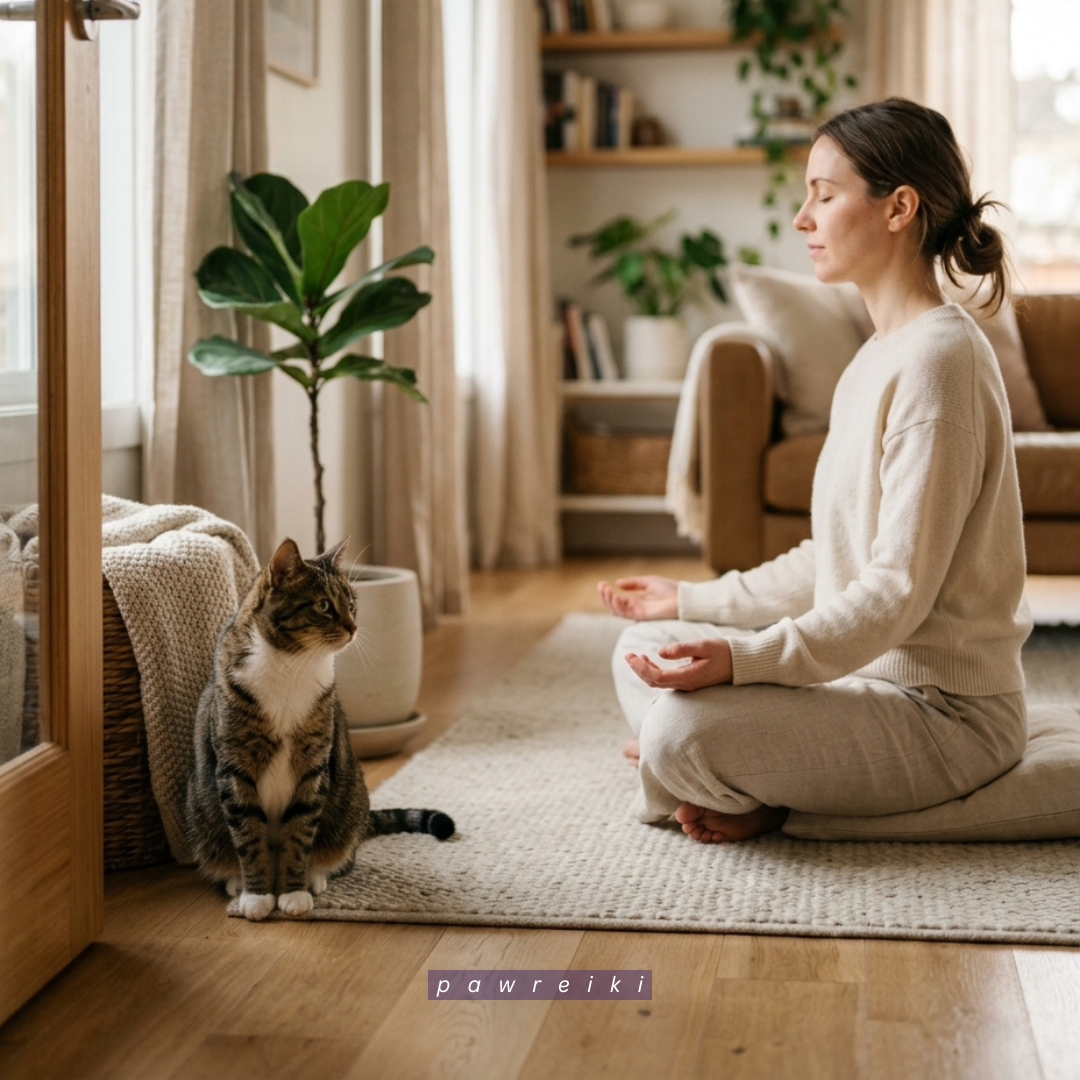
Hands-off Reiki can be a gentle starting point for a fearful cat, especially if they become tense when someone reaches toward them. Sit quietly with your hands resting comfortably, and let your cat stay wherever they feel secure.
You don’t need to decide immediately whether physical contact should become part of the session. Giving your cat plenty of space removes that pressure and allows them to control the distance between you.
Your cat may stay across the room, settle nearby, or gradually move closer. Continue offering Reiki without changing your position simply because your cat has approached.
If your cat eventually seeks familiar physical contact, you can respond according to their usual preferences. Until then, hands-off Reiki allows the experience to remain quiet, optional, and centred around your cat’s comfort.
Key Point
Hands-off Reiki keeps physical contact optional and allows a nervous cat to choose the distance that feels most comfortable.
Step 6: Watch The Whole Cat, Not One Body-Language Signal
A single behaviour rarely tells the complete story. A cat sitting still may be resting comfortably, or they may remain motionless because they feel uncertain.
Hiding can also mean different things depending on the situation. It may simply be your cat’s preferred way to retreat, or it may appear alongside other signs that suggest discomfort.
Look at several signals together, including posture, movement, ears, facial expression, grooming, appetite, play, exploration, and willingness to interact. Together, these signals can give a clearer picture of how your cat is feeling.
Rather than trying to diagnose fear during a Reiki session, become familiar with what is normal for your individual cat. Cat parents who also work with chakras may find it helpful to understand signs of chakra imbalance in cats as part of their broader energy-healing practice.
Key Point
Consider your cat’s overall body language and behaviour rather than interpreting one signal on its own.
Step 7: Keep The Session Short Enough To Remain Comfortable
There is no ideal Reiki session length that suits every fearful cat. A few quiet minutes may be enough for one cat, while another may remain comfortably nearby for longer.
Rather than watching the clock, pay attention to your cat. If they become tense, restless, or begin moving away, allow the session to end naturally.
Short or long Reiki sessions can both have a place depending on the individual animal. Your cat’s comfort and willingness to remain nearby are better guides than trying to reach a predetermined number of minutes.
Keeping the timing flexible also removes pressure from the experience. Reiki can remain a quiet opportunity to spend time together rather than something your cat is expected to complete.
Key Point
Let your cat’s comfort determine the length of the Reiki session rather than following a fixed time.
Step 8: Respect Your Cat’s Decision To Leave
Your cat should always be free to end a Reiki session. If they get up, walk away, or move to another part of the room, allow them to go without following or encouraging them to return.
This can be especially important for a fearful cat. Knowing they can control their distance helps keep the interaction gentle and prevents Reiki from becoming something they are expected to tolerate.
Try not to measure a session by how long your cat stays or how close they sit. A brief period of quiet Reiki followed by your cat walking away is still a complete experience.
Respecting their decision to leave also supports the trust you are building. The next Reiki session can begin as another invitation rather than something your cat remembers being unable to escape.
Key Point
Allow your cat to end the Reiki session whenever they choose, without following or encouraging them to return.
Step 9: Respect Your Cat’s Hiding Place
For many fearful cats, a hiding place provides security when their surroundings feel overwhelming. Under a bed, behind furniture, or inside a covered cat bed may be exactly where your cat wants to be.
If your cat retreats during Reiki, leave their hiding place undisturbed. You may remain quietly nearby if your presence seems comfortable, but there is no need to coax them back into the room.
Reiki can also be offered from a distance without requiring your cat to emerge. Their hiding place remains a refuge while you respect the physical space they have chosen.
Keeping that refuge available reinforces an important message throughout the session: your cat controls their participation, including when they prefer not to participate at all.
Key Point
Treat your cat’s hiding place as a safe refuge and never coax them out simply to continue a Reiki session.
Step 10: Keep A Simple Reiki Journal
A simple Reiki journal can help you notice patterns in your cat’s preferences without expecting every session to produce a visible response. Record the date, approximate session length, and where your cat chose to stay.
You might also note whether they approached voluntarily, remained at a distance, moved away, or rested nearby. Changes in posture and behaviour before, during, and after the session can provide useful context.
Include anything unusual that may have influenced your cat that day, such as visitors, household noise, another pet, or a change in routine. These details can make patterns easier to recognize later.
After several sessions, you may notice that your cat prefers certain locations, times of day, or distances. The journal helps you understand your cat’s individual Reiki preferences, rather than trying to prove that Reiki caused a particular change.
Key Point
Use your Reiki journal to notice your cat’s preferences and patterns without expecting a particular result.
Common Signs Of A Fearful Cat
Fear can appear differently from one cat to another. Some cats make their discomfort obvious by running away or hiding, while others show much quieter changes in their behaviour.
Understanding your cat’s usual habits can make these changes easier to notice. Body posture, appetite, grooming, sleep, and willingness to interact can all provide useful clues.
One behaviour on its own does not necessarily mean your cat is fearful. Looking at several signs together and considering what is happening around your cat can provide a clearer picture.
The following signs may help you recognize when your cat feels uncertain or uncomfortable. They can also help you decide when extra space, patience, and a quieter environment may be helpful.
1. Hiding For Long Periods
A fearful cat may spend long periods under beds, behind furniture, or inside closets, especially after unfamiliar sounds, visitors, or changes in their surroundings.
Occasional hiding is a normal part of feline behaviour. However, hiding more often or staying secluded after the home becomes quiet may suggest your cat feels unsettled.
Watch for changes from your cat’s usual habits. Changes in how often or how long they hide can provide useful clues about their comfort level.
2. Startling At Everyday Sounds
Fearful cats may react strongly to ordinary household noises such as a closing door, footsteps, or a ringing phone. They may jump, run away, hide, or suddenly become alert.
While many cats startle occasionally, a fearful cat may take longer to settle after the sound has stopped. They may remain watchful or tense even when the surroundings are quiet again.
Noticing how quickly your cat returns to their usual behaviour can help you tell whether everyday sounds cause ongoing uneasiness.
3. Avoiding People Or Other Pets
Some fearful cats leave the room when someone approaches, or another pet comes nearby. Keeping their distance may help them feel safer and more in control of the situation.
They may also avoid familiar family members or pets they previously spent time around. A noticeable change in social behaviour can be particularly useful to watch for.
Giving your cat space and allowing them to approach in their own time can help reduce pressure. Quiet, predictable interactions can also provide opportunities to gradually build trust.
4. Remaining Constantly Alert
A fearful cat may find it difficult to fully relax. Their ears may continually turn toward sounds while their eyes closely follow movement around the room.
Even when nothing threatening is happening, they may appear ready to retreat at any moment. Their body may remain tense rather than settling into a comfortable resting position.
Watching how your cat behaves during genuinely quiet periods can be helpful. A cat that remains unusually watchful may still feel uncertain about their surroundings.
5. Hesitating To Explore New Spaces
Fearful cats may take extra time to enter a new room or approach an unfamiliar object. They may remain at a distance and quietly observe before deciding whether to move closer.
Changes such as new furniture, visitors, or unfamiliar items can make some cats particularly cautious. Give them time to investigate without encouragement or pressure so they can move at their own pace.
As your cat becomes familiar with the change, they may gradually begin exploring. Their willingness to investigate can provide useful clues about how comfortable they feel in their surroundings.
9. Excessive Grooming Or Reduced Grooming
Fear can sometimes change a cat’s normal grooming habits. Some cats may repeatedly lick the same areas when they feel unsettled, while others may stop taking their usual interest in keeping themselves clean.
A frightened cat that spends much of the day hiding may also groom less than usual. Their coat may gradually begin to look dull, unkempt, or matted, particularly if the change continues.
Pay attention to what is normal for your cat. A noticeable increase or decrease in grooming, especially alongside hiding, appetite changes, or other unusual behaviour, is worth watching closely.
10. Remaining Alert While Resting
A fearful cat may struggle to settle into deep, comfortable sleep. They may wake at small sounds, frequently lift their head to check their surroundings, or move from one sleeping place to another.
Some cats choose tucked-away sleeping spots where they feel less exposed. Others may appear to be sleeping but remain ready to get up quickly if someone approaches or something changes around them.
Pay attention to how your cat rests when they feel uncertain. Frequent waking, choosing protected sleeping spots, or remaining alert while resting can be signs that your cat does not yet feel completely safe in their surroundings.
Frequently Asked Questions
Q1: Can Beginners Practise Reiki For Fearful Cats At Home?
Yes. Beginners can share simple, hands-off Reiki with a fearful cat in a quiet and familiar space. There is no need to touch your cat or encourage them to come closer.
Start gently and allow your cat to decide where they want to be. Their comfort and freedom to leave should guide the experience.
Q2: How Often Can I Practise Reiki With A Fearful Cat?
There is no fixed Reiki schedule that suits every cat. Some cats may be comfortable with regular quiet sessions, while others may prefer them less often.
Follow your cat’s response rather than the calendar. If they move away or seem uncomfortable, simply end the session and try again another time.
Q3: Can I Offer Reiki While My Cat Is Hiding?
Yes. You can offer hands-off Reiki from a respectful distance without disturbing your cat or trying to coax them from their hiding place.
For a fearful cat, that hiding place may be where they feel safest. Allowing them to remain there keeps participation entirely their choice.
Q4: Does My Cat Need To Sit Still During Reiki?
No. Your cat can walk around, change positions, watch from across the room, or leave altogether. They do not need to sit beside you for a Reiki session.
Allowing your cat to move freely is particularly important when they are fearful. Reiki should never make them feel confined or pressured to stay.
Q5: Can I Touch My Fearful Cat During Reiki?
Only if your cat is already comfortable with your touch and voluntarily seeks that contact. Hands-off Reiki is often a gentler choice when a cat is nervous about being approached.
If your cat comes closer, continue watching their body language. Moving away is a clear reason to give them space again. Let your cat decide whether physical contact becomes part of the Reiki session.
Q6: Can Reiki Be Used Alongside Other Calming Routines?
Yes. You can incorporate Reiki into a peaceful routine that includes familiar resting places, gentle interaction, enrichment, and meditation for cats, while giving your cat plenty of opportunities to retreat.
The important thing is not to overwhelm a fearful cat with too many new experiences at once. Keep their surroundings familiar and allow them to move at their own pace.
Helpful External Resources
If you’d like to explore pet wellness, behaviour support, or gentle healing practices further, here are trusted organizations and educational resources you may find helpful:
- American Veterinary Medical Association (AVMA) – General pet health, behaviour guidance, and care resources.
- ASPCA Pet Care Library – Behaviour tips, anxiety support, and animal-care information.
- VCA Animal Hospitals: Know Your Pet – Comprehensive articles written by veterinarians.
- International Center for Reiki Training (ICRT): Animal Reiki – Introductory information and classes for working with animals.
- Shelter Animal Reiki Association (SARA) – Ethical, animal-led Reiki practices and training.
Conclusion
Living with a fearful cat often means learning to appreciate the small moments. Sitting nearby instead of hiding, remaining in the room when someone enters, or choosing to come a little closer can all feel significant.
Reiki for Fearful Cats provides a quiet way to spend time together without expecting your cat to behave differently. They can remain at a distance, approach when they choose, or leave whenever they have had enough.
Some sessions may last only a few minutes, while others may continue as your cat rests nearby. You don’t need to measure progress or look for a particular response after every session.
What matters most is respecting the cat in front of you. Give them space, notice what makes them comfortable, and let Reiki become one of the peaceful moments you can share together.
I trust you enjoyed this article on Reiki for Fearful Cats: A 10-Step Guide for Cat Parents. Please stay tuned for more Reiki insights, pet wellness tips, and holistic lifestyle ideas.
Take care!
— JeannetteZ 🐾💜
💬 Your Opinion Is Important To Me
Do you have thoughts, ideas, or questions? I’d love to hear from you. Please leave your comments below or email me directly at Jeannette@pawreiki.com.
📚 More PawReiki Reads — Discover Energy Healing & Holistic Pet Wellness
💜 My #1 Recommendation for Online Success
Reiki has brought so much peace and purpose to my life, and sharing it online has been a true blessing. If you’ve ever dreamed of creating a gentle income stream around your love for animals and holistic healing, this platform gives you all the tools, training, and community support you need — no tech experience required.
🌟 See How Reiki Lovers Build Online Income — Try WA FreeNo credit card required · Free starter training included
Disclosure
This post may contain affiliate links. As an Amazon Associate and participant in other affiliate programs, I earn from qualifying purchases at no extra cost to you. Please read my full affiliate disclosure.